Skip to the races

The 20 strangest state legislative races of 2026

Party switches. Arrested incumbents. And of course, write-ins.

Ten districts that I find interesting and ten that are crazy.

One of the number one reasons I enjoy analyzing, forecasting, and following state legislative elections is that they’re far more interesting than federal elections. That includes, but is not limited to, high ticket-splitting rates, local politics dominating results, differences in campaigning techniques and style, and, perhaps most importantly, their strangeness.

With 6,152 state legislative seats up for election this year, the law of large numbers allows for messier, crazier elections than you’ll see at the congressional level: for every Max Miller or George Santos in Congress, there are ten of them at the state legislative level. You’ll also sometimes see somewhat British-looking elections where multiple candidates vie for a single-member seat, splitting the vote in unique ways that no longer appear at the congressional level.

In my nine years of following state legislative elections around the country, I’ve seen ridiculously crazy state legislative elections, including an alleged wife-beater win by one vote, an incumbent win after killing a kid’s dog in the home stretch, death threats made against fellow state legislators, an incumbent calling a constituent a “foreclosed loser”—I’ll stop here; I could keep going for days.

Up until now, I’ve never written an article summarizing the strangest races of the year; I've always just briefly mentioned them in each state’s final forecast article. This year, I’m starting a tradition of picking my top ten craziest and top ten most interesting state legislative elections for each cycle, starting with 2026. We’ll alternate between crazy and interesting as we work our way up to the #1 spot.

Forecast figures update from the national forecast’s daily export. Current figures are from October 11, 2026.

All politics is local. And strange.

Pick a district, or scroll through my rankings.

Crazy #10

HI HD-43Hawaii

The Easter Egg Election

An 842-842 tie, a lauhala basket, two misassigned ballots and a Supreme Court order. The Kapolei rerun is a Republican “primary” that every voter gets to decide.

Cartoon hand draws from a basket with two Easter eggs and equal ballot stacks.

Kanani Souza lost her seat in the Hawaii House of Representatives on August 15th when the state's chief election officer, eyes averted, reached into a woven basket and pulled out a plastic egg with her opponent's name inside. Three weeks later the Hawaii Supreme Court gave her an opportunity to win it back.

House District 43 covers Kapolei and Makakilo on Oahu's west side, and it is one of the few places Republicans have made gains in Hawaii this decade. Kanani Souza (R), an attorney and former Honolulu deputy prosecutor, flipped the seat in 2022 by ousting Democratic incumbent Stacelynn Eli 55.5% to 44.5%. In 2024 she turned back a Republican primary challenge from Sheila Medeiros, a retired Army lieutenant colonel and former legislative staffer, 58% to 42%, and then faced no Democrat at all in November in a district that voted for President Biden in 2020 but voted for President Trump in 2024 by 2.5%. In 2026, once again, no Democrat filed. That meant the August 8th Republican primary rematch between Souza and Medeiros was, in effect, the election.

Election night printouts had Souza ahead 841 to 840, the closest race in the state. An automatic recount kept her up by one. Then the five-day window for voters to cure signature problems on their mail ballots added 30 more votes, and the count landed at 842 to 842, Hawaii's first primary tie since 1988. Under state law a tie is broken by lot. So on August 15th, in a basement auditorium at the Capitol in front of about 25 people, an elections specialist printed each name, folded it three times, sealed it inside an Easter-egg-style capsule, dropped both into a lauhala basket and shook it. Chief Election Officer Scott Nago drew Medeiros. The same ceremony, minutes apart, also ousted Senator Kurt Fevella in favor of Bob McDermott in a 1,212-1,212 tie in Senate District 20. Even the winner was unimpressed: "It's like gambling. We just chanced it," Medeiros said.

Souza, representing herself, filed a 144-page election contest with the Supreme Court on the last possible day. She alleged the eggs had not been shuffled, that the drawing procedure had never been adopted as a rule, that the "by lot" statute itself is unconstitutional, and that a two-ballot overage in Precinct 43-03 had never been reconciled. That last point turned out to be the one that mattered to the court. On September 1st the City and County of Honolulu admitted that two Ewa Beach walk-in voters registered in Precinct 40-03 had been handed District 43 ballots at Kapolei Hale on primary day. The city flagged the error to the state that same day. The state elections office did not notice until after it had already broken the tie. At the September 2nd hearing, Nago told the justices that "in our minds, the results are the results" and conceded there was no written rule for tiebreakers at all.

On September 4th the court threw out the result. "A tie must be real before it can be broken," Justice Todd Eddins wrote; two stray ballots in a race decided by zero votes meant the state had never established one. The justices also held that the egg-and-basket procedure was an unpromulgated rule that should have gone through public notice and comment, and ordered Nago to write one. The remedy to all of this was controversial.

The court ordered a new election between Souza and Medeiros on the November 3rd general election ballot, in a separate section labeled "Republican Party Voters Only." Hawaii has no party registration, so every District 43 voter can mark it. Justices Eddins and Sabrina McKenna dissented on the remedy, arguing it conflicts with state election law and that a stand-alone rerun after November would have been cleaner; the court denied both candidates' motions to reconsider on September 16th and 17th. Fevella's parallel petition in SD-20 was tossed as untimely, so McDermott's egg-draw win stands.

The result is a general election that is technically a party primary and functionally neither. Souza worries the "Republicans only" label will scare off the non-Republican voters she needs in a district that turned out only 1,684 primary voters; Medeiros argues it is unfair for general-election voters to settle a GOP nomination but says she will compete. Civil Beat's Chad Blair has reported that the ruling may still conflict with state law, and an Elections Commission member has called for Nago's firing. Our forecast still scores the seat as a certain Republican hold, which it is, in the narrow sense that both names on the ballot are Republicans. Imagine if it ties again. There is no way to forecast the winner in a race like this one, and we are not going to pretend otherwise.


Interesting #10

KS HD-3Kansas

Ten Minutes to Spare

An incumbent hands off his seat to his preferred successor, who faces a Democratic Socialist in a Trump-voting small town.

Cartoon Chuck Smith driving with a filing folder beside a stopwatch.

Chuck Smith originally filed for re-election to the Kansas House. Then, on Monday, June 1st, the filing deadline, the 74-year-old drove the 170 miles from Pittsburg to Topeka and walked into the Secretary of State's office minutes before noon to take his name back off the ballot. "One hundred seventy miles and 10 minutes to spare," he told the staff, per Kansas Reflector's Baya Burgess.

He had not come alone. Smith had personally recruited DJ Perry, a 25-year-old Pittsburg city commissioner who had been in elected office for all of five months. Perry filed that morning with the Crawford County GOP chair at his side, and was the only Republican to do so. The result was a textbook incumbent handoff: no primary, no open-seat scramble, a successor chosen by the man leaving and installed with the clock running out. In a state known for brutal Republican primaries over the past decade, the move has become a Kansas habit, particularly on the Republican side: it spares an incumbent’s chosen successor a contested nomination.

House District 3 is located in the state’s southeast corner, containing Pittsburg and Pittsburg State University. It leans Republican, having voted for Trump by 14 points in 2024, though it voted for Governor Laura Kelly (D) by 5 points in the 2022 gubernatorial election. Democrats lost this seat in 2020 when Smith ousted two-term incumbent Democrat Monica Murnan by 8 points. Smith was left uncontested in 2022, and won re-election by 20 points in 2024.

Two Democratic candidates competed for the nomination this year: Isaiah Harris, a Pittsburg State graduate who works full time at a Dillons grocery store, and Isys Galindo, a 19-year-old 2024 Pittsburg High School graduate. Harris won the August 4th primary 68% to 32%. He is an unusual nominee for a Trump +14 district: he’s an open member of the Democratic Socialists of America, running on a $15 minimum wage, Medicaid expansion and cannabis legalization. This isn’t Harris’s first run against Perry, though: on November 4th, 2025, Perry and Harris ran against each other for Pittsburg City Commission. Perry won a seat with 1,187 votes; Harris finished fifth with 995 and lost.

Our forecast projects Perry to win by 2.1 points, with a 62% chance of victory. The race will be a test of whether there’s an appetite for midwestern socialism in a rightward-trending district. Should Harris pull off an upset, he’ll likely owe it to an ability to motivate students in the district to get off the sidelines to support his campaign, and voters’ dissatisfaction with their district being handed off without their having a say in the process.

Crazy #9

FL HD-106Florida

Will Fabian Basabe be Cancelled?

A jury found the Miami Beach Republican liable for sexual harassment, battery and defamation in July. He promised in 2024 to resign if any allegation were proven. He has hired a Trump lawyer instead.

Cartoon Fabian Basabe on a campaign sign planted on a beach beside a gavel and palm tree.

In the lead up to finalizing our forecasts in the 2024 election, I stumbled across what is one of my absolute favorite articles written about a state legislative candidate by Ben Widdicombe at New York magazine’s Intelligencer. Perhaps there’s something about people with “-combe” in their surname who just have a knack for state legislative journalism? I jest, I jest.

Fabián Basabe is one of roughly a dozen openly gay Republican state legislators in the country, and one of two running for re-election in a district that voted for President Biden in 2020 but flipped to President Trump in 2024 – the other is Matt Gress (R) in AZ LD-4. Florida House District 106 runs up the coast from Miami Beach through North Bay Village, Bay Harbor Islands and Sunny Isles Beach to Aventura. Biden carried it by 10 in 2020 and then Trump carried it by 9 in 2024, swinging twice as hard toward Trump between 2020 and 2024 as Florida did statewide.

The former party boy and reality TV star with devilish good looks fittingly represents one of the party capitals of the country: Miami Beach. He flipped the district red in 2022 by 240 votes after a recount and in 2024 beat Democrat Joe Saunders 51% to 47%, with Saunders's estranged aunt siphoning 1.7% as a “no party affiliation” candidate. He did that while under investigation by the Los Angeles County Sheriff over a man's sworn account that Basabe drugged and raped him in Malibu in 2003. He was never charged, and in an October 2024 video he promised to "resign on the spot" if any allegation against him were ever proven true.

On July 15th, 2026, a Leon County civil jury deliberated for about two hours and found him liable for sexual harassment, battery and defamation, awarding $450,000 to two former staffers, aide Nicolas Frevola and intern Jacob Cutbirth, who had accused him in 2023 of slapping their butts, groping and unwanted advances. A House-commissioned probe back then had called the complaints inconclusive. At trial, Basabe, who is not a lawyer, represented himself after his attorney withdrew, violated Judge J. Lee Marsh's orders seven times ("staggering how blatant," the judge said), rested without calling a witness, and later called that "a mistake."

He has not kept his October 2024 campaign promise; he has not resigned. Florida Trib's Kate Payne laid out the pledge and the evasion: Basabe argues nothing is "proven" while he appeals. He hired Trump-allied lawyer Peter Ticktin, moved for a new trial and for Marsh's recusal on the ground that the plaintiffs' lawyers sit on the judge's re-election committee, a fact video shows was disclosed before trial. Marsh denied everything on August 20th and entered final judgment. Basabe told Local 10 in September it is "lawfare" and that he has "made a lot of really powerful enemies." House Speaker Daniel Perez and incoming Speaker Sam Garrison have taken no action and have made no comment, as far as I can find. Five of seven Miami Beach commissioners say he should resign, and a state representative, a Sunny Isles vice mayor, two commissioners and a council member have rescinded endorsements. Last week Florida Politics reported he touted an endorsement from an 84-year-old education activist who says she never gave it.

The Democrat is Lucía Báez-Geller, 41, who taught English at Miami Beach Senior High for 15 years, won a Miami-Dade School Board seat in 2020 with 61% as its most progressive member, but handily lost to Congresswoman María Elvira Salazar in the 2024 FL-27 congressional election. Our forecast projects Báez-Geller to win by 5.6 points, with a 79% chance of victory. That is roughly the edge we gave Democrats in 2024, and Basabe defied it. Maybe he’ll do so again, given how this district bolted rightward that year. The jury that will decide the fate of Basabe’s career isn’t in a courtroom; it’s in the voting booth on election day.

Interesting #9

NY AD-45New York

Two Candidates. Four Ballot lines.

Michael Novakhov won by 232 votes in 2024. Joey Cohen-Saban is back with a "Fight Antisemitism" line, with both candidates trying to appeal to conservative Jewish voters.

Four ballot lines, Democratic and Fight Antisemitism in blue and Republican and Conservative in red, merge into two candidate symbols in front of Brooklyn rowhouses.

Southern Brooklyn's 45th Assembly District was Democrat Steven Cymbrowitz's for two decades until the 2022 red wave crashed upon the shores of Manhattan Beach, when Michael Novakhov (R) beat him by 19 points in a district that stretches across Midwood, Manhattan Beach, Brighton Beach, Gravesend and Sheepshead Bay, home to the city's largest Russian-speaking Jewish community and a large Syrian Sephardic one. Two years later Democrats nearly won it back, despite the district voting for President Trump by 51 points.

Democrat Joey Cohen-Saban held him to 15,383 votes to 15,151, a 232-vote margin, with Novakhov's 1,323 votes on the Conservative line making the difference. It is now one of the few competitive Assembly seats in New York City. The rematch was set on April 1st, when Cohen-Saban announced he was running again, claiming Novakhov had "not passed a single piece of legislation" in nearly four years (to be fair though, it’s a hard task to get your bills passed when you’re in the superminority).

Cohen-Saban is a product of the community, a Yeshivah of Flatbush and George Washington University graduate, a Brooklyn Democratic district leader and a Sephardic Community Federation board member. He managed State Senator Sam Sutton's winning 2025 special election campaign and now serves as Sutton's chief of staff.

Novakhov is a Soviet-born immigrant and Manhattan Beach resident who co-founded the Russian-language station Freedom FM; his campaign is built on public safety, fighting antisemitism and opposition to Mayor Zohran Mamdani. He led the cancellation of an Uzbek singer's Brighton Beach concert over antisemitic remarks and in August filed a civil rights complaint with the Justice Department over antisemitic attacks and the mayor's record.

New York is one of a handful of states that allow “fusion voting”: a candidate can be nominated by more than one party and appear on the ballot once for each, and every vote cast on every line is added together. Most states banned the practice a century ago; New York kept it, and tried to kill it in 2019 before the courts and the Legislature backed off. The result is that a Democrat usually also runs on the Working Families line and a Republican on the Conservative line, and the minor party’s votes can decide a close race. A 2020 rewrite of the ballot-access rules raised the threshold for permanent party status and wiped out the Independence, Green and Libertarian lines, leaving four parties with automatic ballot access statewide. Anyone who wants an additional line has to invent one. State law lets a candidate create an “independent body” by collecting signatures, 1,500 of them for an Assembly seat, and give it any English-language name that cannot be confused with an existing party’s.

Fusion voting makes the ballot lines a contest of their own. In 2024 Cohen-Saban tried to create a "Pro-Israel Party" line and withdrew it; this year he succeeded with a line called "Fight Antisemitism.” Novakhov, meanwhile, headlined a May 17th "Stop Mamdani" rally on the Brighton Beach boardwalk whose stated purpose was gathering signatures for an independent "Stop Mamdani" line that he and other Republicans planned to run on. That line appears next to the Republican candidate in AD-47 but not next to Novakhov, who will appear on the Republican and Conservative lines again.

The freshest wrinkle broke last week. Jewish Insider's Will Bredderman reports that a committee called Kings County Victory Project registered in late September to boost three Democrats against southern Brooklyn's Republican Assembly incumbents, including Cohen-Saban. Its treasurer, Mark Hanna, is also treasurer of the anti-AIPAC American Priorities PAC and an ally of the mayor. Cohen-Saban said he knew nothing about the group and that "I don't welcome their help" unless Hanna changes his position on Israel and denounces a Brooklyn district leader whose resignation Cohen-Saban led the call for in August over antisemitic conduct. Novakhov's response: "my opponent keeps very bad company."

Working in Novakhov’s favor is Governor Hochul’s meager standing in the polls relative to New York’s partisan lean, national survey data showing Republicans gaining among Jewish voters up about 7 points since 2024, despite a favorable Democratic environment, and a new mayor who is deeply resented by the community. Still, Cohen-Saban outran the top of the ticket by 50 points in 2024 and has a new “Fight Antisemitism” line that could put him over the top. Our forecast projects Novakhov to win by 0.6 points, with a 54% chance of victory.

Crazy #8

CT HD-8Connecticut

I Hate Connecticut Nazis

The first Republican choice withdrew after his arrest record surfaced. His 21-year-old replacement now faces a controversy of his own.

A simple cartoon Will Gifford with a high, thin hairline holds a microphone beside campaign signs.

Tim Ackert held Connecticut's 8th House District for 16 years, and when he decided to leave it this spring the Republican bench in eastern Tolland County turned out to be exactly two people deep. The first was arrested for painting swastikas. The second is a 21-year-old Turning Point student.

HD-8 is Columbia and Coventry plus Bolton, Lebanon and part of Tolland, a rural pocket that still leans Republican downballot in a state that gave Harris 56%. Ackert, a Coventry electrical contractor, beat Democrat Nancy Hammarstrom 59% to 41% in 2024. In April he left to become Erin Stewart's running mate for lieutenant governor. Stewart quit the governor's race a month later over a city credit-card investigation; Ackert stayed in and was crushed by Matt Corey at the May 16th convention, conceded rather than primary, and then, per Kevin Rennie's Daily Ructions, emailed his House colleagues that he would not seek another term and that they had disappointed him.

Michael Carroll, a Columbia Republican and 2013 lottery winner, was Ackert's pick to succeed him until a House GOP staffer turned up Carroll's 2017 state police arrest for painting Nazi and KKK graffiti, and "Trump," on nine properties. Carroll withdrew in April. The Coventry Republican Town Committee then nominated William "Will" Gifford, who, by Ackert's own account to the Hartford Courant, was the only person who volunteered to run. Gifford is a 21-year-old Columbia resident, a UConn junior studying journalism and communications, president of the campus Turning Point USA chapter, and a Norwich Tech-trained auto technician who says he owns a small automotive business. He faces Democrat Francis Lombard, a small-business owner, in the general election.

On September 22nd, CT Mirror's Mark Pazniokas reported that House Speaker Matt Ritter was "aghast" at a sub-one-minute Instagram clip Gifford had posted from Turning Point's AmericaFest in Phoenix last year. In it Gifford asks podcaster Joshua Haymes, a Christian nationalist and former pastor at Pete Hegseth's church, whether it is antisemitic to dislike someone for being Jewish. Haymes answers, "Your religion is evil." Gifford nods, says "Yes," and moves on. Ritter said it should end the campaign and that House Democrats would "invest" in the race to make sure voters saw it. Gifford added a disclaimer calling Haymes's remarks "hateful and false" but told the Courant he would neither withdraw nor apologize, because "it's not our job to correct what people are saying."

This district voted for Kamala Harris by just 1.6% in 2024, and Connecticut Republicans have had a notoriously hard time holding blue or even purple seats once an incumbent leaves, ever since Donald Trump arrived on the political scene and on the minds of Connecticut voters. Our forecast projects Lombard to win by 6.6 points, with a 83% chance of victory.

Interesting #8

RI HD-15Rhode Island

The Fungs’ Feud

Allan Fung quit the Republican Party to run as an independent for the seat his wife held, against a Republican incumbent who works for the mayor the Fungs cannot stand.

Simple cartoon Allan Fung and Ken Hopkins pull apart a red ribbon over a breakfast table while a blue ballot falls between them.

For most of the 2010s, Allan Fung was the Republican Party in Rhode Island: three-term mayor of Cranston, the party's nominee for governor in 2014 and 2018, its nominee for the state’s one competitive congressional seat in 2022. His wife, Barbara Ann Fenton-Fung, pulled off the state's biggest legislative upset of 2020 by ousting House Speaker Nicholas Mattiello (D) in House District 15 by about 18 points, running as a pro-choice Republican against the anti-abortion Speaker. On May 6th of this year, both of them disaffiliated from the Republican Party, and on June 24th Fung filed as an independent for the seat his wife used to hold.

The seat is in western Cranston, one of the few reliably Republican pockets in statewide elections in Rhode Island, where Democrats hold a supermajority in the 75-member House of Representatives. Rhode Island, by the way, has the country’s highest share of districts that voted for Donald Trump in 2024 but elect Democrats, and 11% of its legislative districts went for Trump but have a Democrat running unopposed this fall.

Fenton-Fung gave up her seat in 2024 to challenge Cranston Mayor Ken Hopkins in the Republican mayoral primary and lost badly, 59-41. The open House seat went to Republican Chris Paplauskas, a five-term city councilman, who beat Democrat Maria Bucci by 22 votes on election night and 26 after a recount. Paplauskas is now deputy chief of staff to Mayor Hopkins, who has been feuding with the Fungs.

In April 2024 Hopkins accused Fung of asking him over breakfast to steer city legal business to Fung's law firm and walking out when refused; Fenton-Fung's primary challenge to Hopkins followed within months. Now Fung, 56, is running against the mayor's own deputy. His stated rationale: "My loyalty is to the people I represent, not a political party," and that politics has become about protecting "insiders" and "political tribes." Paplauskas's reply was snarky: "Mr. Fung has not won an election in a decade, but I have no doubt he is eager to return to elected office." Independent Rep. Jon Brien told Rhode Island Current the switch was a way to dodge a primary; Fung called that "ridiculous,” but given his wife’s poor performance in the 2024 primary, the accusation isn’t without merit.

Republicans are furious with Fung for splitting the conservative vote. An anonymous Rhode Island Republican Substack called Fung's run "reckless, self-serving" and warned it could hand Democrats a seat that voted for Trump by 9 points in 2024. The Democrat is Colleen M. Crudele, a local attorney. She’s run a meager campaign thus far, with less than $2,000 cash on hand versus Fung’s $58,000 ($50,000 of which comes from a personal loan from himself) and Paplauskas’s $21,000. Still, our forecast does believe the conservative vote being split makes this race a toss-up once again, just as it was in 2024: Crudele has a 55% chance to win, with the other 45% split between Fung and Paplauskas. The question for November is simple: does the Fung name still carry Cranston, or does it just carry enough of it to elect a Democrat?

Crazy #7

IA HD-87Iowa

Horse Paste on the House Floor

A district like this has no business being a single-digit race in 2026. But the incumbent can’t help but continue making crazy and offensive comments.

A cartoon horse and veterinary tube with Jeff Shipley’s portrait, surrounded by censored messages.

Iowa Democrats keep saying “he can’t keep getting away with it!” each election cycle. There is perhaps no other state legislator in the country who has a longer list of crazy and offensive comments made during their tenure than Jeff Shipley (R) of Iowa House District 87, containing the towns of Fairfield, Keosauqua, and Mount Pleasant. It’s supposed to be a district that is guaranteed to elect a Republican by double-digits this year, having voted for Trump by 21 points in 2024. Shipley, though, is a notorious electoral underperformer due to his controversial statements. Let’s rewind.

Shipley lost the old iteration of HD-82 in 2014 when he was just 26. A Fairfield legal assistant and sauerkraut salesman, he got his seat almost by accident. No Republican filed for the old HD-82 in 2018, so the district party nominated him at a summer convention. With Young Americans for Liberty running his door program and less than $20,000 spent, he beat four-term Democrat Phil Miller by 37 votes after a hand recount, running behind Kim Reynolds’ margin in the district by 11 points.

His first session was a wild one for sure. He filed bills to let hospital workers refuse immunizations, to take psilocybin off Schedule I and to require every high schooler to read Solzhenitsyn to graduate. In December 2019 he told California state Senator Richard Pan, a pediatrician who wrote that state's vaccine law, that he was "a medical rapist," then apologized for the phrase by suggesting "pharma fascist" or "corporate vaccine whore" would have been more accurate. Then came the pandemic. In April 2020 he tweeted that young people had "a greater chance of being killed by the HPV vaccine than COVID-19," admitted to a student reporter he had no data, and earned a Pants on Fire from PolitiFact. On June 3rd that year, the Legislature's first day back, he told an anti-mandate rally on the Capitol steps that "this virus isn't even killing anybody". He called his masked colleagues' face coverings "virtue signaling," said a safe vaccine was "probably impossible to develop," and then returned to the microphone to call Bill Gates "a monster," concede that "no one is dying" was "not technically true," and announce that he identifies "as an eternal spirit which will live on long after my body passes." Iowa Starting Line counted 249 tweets from him over the 12 session days, including calling a state epidemiologist "a sniveling coward" and a gay legislative candidate "a walking public health crisis." Back in Fairfield, his former mentor called him "an exceptionally dangerous person.”

Miller was asleep at the wheel during his 2018 re-election bid, but both candidates and their parties fought like hell during the 2020 half-a-million-dollar rematch. Miller’s team spent three times as much as Shipley’s, but it wasn’t enough to overcome Trump winning the district by 29 points in the concurrent presidential election. Shipley won by just 166 votes. After that, Iowa Democrats were exhausted and threw in the towel during the 2022 election cycle. Redistricting did move the district 7 points leftward, and the new map put him in a 2022 primary against fellow Republican incumbent Joe Mitchell, which he won 55-45. In the 2022 primary, by Laura Belin's count, at least 26 House Republicans, all three county sheriffs, Agriculture Secretary Mike Naig and the Farm Bureau backed Mitchell. Shipley nearly did not make that ballot: a botched filing left him with 53 signatures against a 50-signature minimum, a Republican-drafted objection challenged five of them, and the two Democrats on the State Objection Panel outvoted Secretary of State Paul Pate to keep him on.

Earlier that year, on the first anniversary of January 6th, he posted that "agents of the Deep State" had used the riot to "entrap Trump's supporters"; Iowa House Minority Leader Jennifer Konfrst demanded Republican leaders condemn him and Speaker Pat Grassley declined to say anything beyond that he opposed violence. In the 2022 trans-sports debate he compared being transgender to "a malignant sarcoma". In the general election, Shipley won re-election by 11 points, running behind Kim Reynolds’ margin in the district by 10 points: a similar underperformance to 2018, despite no real Democratic effort to beat him.

In January 2023, during the school-choice debate, he suggested a Fairfield teenager might not have murdered his teacher if the family had received a voucher; the board meeting he cited did not exist. In January 2024 his bill to strip gender identity from the Iowa Civil Rights Act, the first of its kind to get a hearing anywhere, died 3-0 in subcommittee as protesters chanted in the hallway, after which he tweeted that civility "is a prerequisite" to civil rights. In the 2024 general election, President Trump carried HD-87 by 21 points while Shipley had his best electoral performance yet relative to previous ticket-splitting differences, winning by 18 points against another lackluster effort to beat him.

In 2025 Shipley carried a bill to make releasing "chemtrails" a felony, telling a subcommittee it was "incumbent on the state of Iowa to exercise sovereignty" over the sky, and filed another to make prescribing mifepristone a Class C felony. On March 3rd this year, during debate on the "Iowa MAHA Act," which made ivermectin available over the counter, Shipley posted a photo of himself on the House floor holding a box of apple-flavored ivermectin horse paste and captioned the 64-30 vote with a remark that "the parasites" were upset. A few weeks later, Iowa Starting Line published video reporting that Shipley had called a Cedar Falls woman who messaged him about the bill a “fagtard.” His apology by Messenger: "I'm sorry for calling you a name, but in my defense you were being super condescending and antagonistic." Little Village's May cover profile reports he told the magazine he had only asked a "rhetorical question," does not consider the words slurs, and supplied a mocking list of definitions.

Now that you’ve got the long, long history of Shipley’s comments over the years (and there are probably some I’ve missed, frankly), we can get into the general election. Shipley is in a rematch with his 2024 opponent, Thomas O’Donnell (D), this time without an Independent on the ballot (in 2024, Independent Curtis Oliver garnered 2.7% of the vote). O’Donnell, the 67-year-old retired Des Moines Register reporter, is running another campaign against Shipley that lacks in-state and national support; he’s all on his own due to Iowa Democrats’ fatigue from 2020. Our forecast projects Shipley to win by 7.1 points, with a 84% chance of victory. But given Shipley’s previous electoral underperformances against gubernatorial margin, if Rob Sand does win the Governor’s race by a margin of at least five points, there’s an outside chance Shipley succumbs to his predecessor’s mistake of taking his race for granted.

Interesting #7

KS HD-80Kansas

The Kid on the Ballot

Bill Rhiley has not had a general election opponent in years. He has one now, and the kid is running on Medicaid expansion in an R+40 district.

A simple cartoon Lex Goff in a flannel shirt holds registration papers alongside classmates.

Kansas House District 80 is a reliably Republican district that voted for Trump by 41 points in 2024, covering the southern tiers of Sumner and Cowley counties along the Oklahoma line and the eastern half of Wellington and all of Arkansas City. Bill Rhiley (R), a former teacher and small-town newspaper publisher who runs a bed-and-breakfast in Wellington, has held it since ousting incumbent Anita Judd-Jenkins in the 2018 Republican primary. In November 2024 he was left unopposed, and it seemed that the same would occur this year: no Democrat filed in 2026.

Then Lex Goff graduated from Wellington High School.

Goff, 18, from a cattle-farming family just outside of Wellington, got into politics the way a lot of people in Wellington did this year: through the school bond. USD 353 put a $22.6 million bond on the ballot in November 2025, and lost. It came back with a $17.85 million version in February 2026 and lost again, this time by 26 votes. Goff had rallied his classmates for both. In March he told KWCH he was running for the Legislature, and in May, a week after graduation, he told Sumner Newscow he would do it as an independent "because neither party is getting the job done."

An independent in Kansas skips the primary but has to petition onto the ballot with signatures from 4% of the district's registered voters, a minimum of 568 in HD-80. Goff turned his in mid-July, and the Secretary of State's office approved the petition in the first week of August. Some people (including his own friends), he told the Wellington News, "registered just so they could sign my petition." If he wins, he would be the youngest person ever to serve in the Kansas House and, as far as anyone can tell, the youngest independent ever elected to any state legislature; recent 18-year-olds who have won legislative seats nationally all did it with a major party behind them.

His independent streak holds up against his unique platform. Goff calls himself a pro-2nd amendment fiscal conservative running on Medicaid expansion, which he ties to the 2020 closure of Wellington's hospital, and supports shifting the property tax burden from homeowners toward corporations, legalizing marijuana, and right-to-repair for farmers. His campaign site advertised an October 3rd event at the Sumner Center to hear former Agriculture Secretary Dan Glickman and KS-04 Democratic nominee Katy Tyndell. He is campaigning from parade floats and community meetings, and he calls his own bid a long shot.

Our forecast projects Rhiley to win by 14.5 points: Goff has a 3% chance of winning. I’ve got this gut feeling, though, that Goff could defy the odds: I’ve seen unique races like this where small town politics with little spending defy the numbers. He could make the race closer than we expect, at least: Laura Kelly lost this district by 13 points in 2022, so it’s worth watching what this young man can do.

Crazy #6

IN SD-22Indiana

Attention, Walmart Shoppers

Ron Alting survived a bruising primary, then stopped campaigning amid a shoplifting investigation and concerns about his health. Early voting had already begun.

Simple cartoon Walmart storefront, an unattended podium, walking shoes and a green pickup truck speeding away.

As of last week, the longest-serving member of the Indiana Senate is on the ballot, under investigation by a special prosecutor, and no longer campaigning. Early voting began the day before he said so.

Senate District 22 is Lafayette and the eastern half of Tippecanoe County plus all of Carroll County, redrawn in 2022 to make it safer for Republicans; it voted for Trump by 14 points in 2024. Ron Alting (R) has held it since 1998 and was left unopposed in 2022. He is 70 and is one of the chamber's more moderate members, having voted against the 2022 abortion ban, the 2022 transgender sports bill and the 2025 DEI bill.

That record brought him a serious primary. Richard Bagsby, a minister, golf-business owner and realtor who had run for the House in 2022, launched in May 2025 with Lieutenant Governor Micah Beckwith at his side, and Beckwith spent the spring attacking Alting's votes. Alting's answer: "I serve District 22, not social media." Then the race became nationalized. In December 2025 the Indiana Senate rejected the Trump-backed mid-decade congressional redistricting plan 19-31, and Alting was one of the 19 yes votes after a major pressure campaign from national conservatives and the White House. That earned him a Trump endorsement even as the lieutenant governor backed his opponent and Governor Mike Braun pointedly declined to endorse him. Alting won on May 5th with 59%, called the Trump endorsement's effect "minimal," and told supporters, "I feel terrible that I let some people down on my vote on redistricting." Bagsby's postmortem: "We were up against all odds. Trump, the Senate Majority Campaign Committee, a 28-year incumbent."

The Democrat is Natasha Baker, a 34-year-old first-time candidate who teaches family and consumer sciences in Battle Ground. Our forecast has viewed Alting as a heavy favorite to win re-election, previously having over a 90% chance of victory. Until last week, this was a race nobody outside of the district was watching.

On October 7th, the Lafayette Journal & Courier's Ron Wilkins and Jillian Ellison reported, citing a source familiar with both incidents, that police suspect Alting of shoplifting twice from Walmart: on September 22nd at the Commerce Drive store in Lafayette, where loss prevention briefly stopped a man and a woman who fled in a green pickup matching the one Alting drives, and on October 1st at the Monticello Walmart near his primary residence. Tippecanoe County Prosecutor Pat Harrington requested a special prosecutor on October 5th, and Elkhart County Prosecutor Vicki Becker was appointed. No charges have been filed. Earlier in the week Alting told Based in Lafayette's Dave Bangert, "I have never been arrested, cited or charged with any crime recently or any time in my entire life."

Then, on the 7th, he issued a statement saying he has "been experiencing concerning changes in my judgment and cognitive functioning," is undergoing medical evaluation and treatment, "did things that were wrong and completely out of character for me," and apologized to his family, his constituents and "the store employees involved." He said he is "stepping back from actively campaigning." He has not withdrawn, and with early voting under way since October 6th, his name is on every ballot. Baker said she was "deeply saddened" and that public service requires "honesty, accountability, sound judgement."

Republican insiders are already discussing a caucus replacement under Indiana's vacancy process if he wins, which they still consider the likeliest outcome despite Alting’s departure from the trail. A seat Democrats had little plausible path to winning now features a first-time candidate against a 28-year incumbent who has said, in writing, that his judgment is impaired. Our forecast projects Alting to win by 3.5 points, with a 70% chance of victory. I’ll definitely be watching this race over the coming weeks to see if Democrats start pouring resources in and how Republicans navigate this October surprise.

Interesting #6

WV SD-1West Virginia

Shawn of the Red

Shawn Fluharty wants to turn a Trump +39 district blue by making the race about the governor. If he pulls it off, he says, call him “Teflon Shawn.”

A slot machine with Shawn Fluharty facing forward between two frying pans, with Patrick Morrisey, Laura Chapman and red and blue yard signs in the other cells.

“If I win this, call me Teflon Shawn,” Delegate Shawn Fluharty (D-Wheeling) says. Fluharty, the House Minority Whip, is trying to defy the odds and turn back the clock in West Virginia’s Northern Panhandle. Running from Weirton through Wheeling to a rural sliver of Marshall County, Senate District 1 hasn’t elected a Democrat to the State Senate since 2018, but Fluharty senses an opportunity against an incumbent he believes to be too close to the Governor for the district’s liking, despite the district backing President Trump by 39 points in 2024.

Fluharty is running against freshman incumbent Laura Chapman (R-Wheeling), one of the most conservative members of the legislature, and a strong supporter of Governor Morrisey. She won the 2022 general election after ousting appointed incumbent Randy Swartzmiller (D) by 20 points.

The 2026 Republican primary was the Northern Panhandle front of the state's GOP civil war. Senator Tom Takubo's center-right, business-backed faction recruited Joe Eddy, the retired president and CEO of Eagle Manufacturing in Wellsburg and a former Manufacturers Association chair, to take Chapman out. Governor Morrisey’s Sugar Maple PAC then spent about $38,000 for Chapman and $53,000 against Eddy; WTOV counted more than $65,000 in pro-Chapman outside money from three PACs combined. Our February primary poll had her at 40 to Eddy's 15 with nearly half undecided, and found that "supporting President Trump" outranked "beating Democrats in November" as a priority for primary voters, even as most Republican insiders we spoke to privately expected Fluharty to beat Chapman. She won her primary on May 12th, 59% to 41%.

Both candidates are attorneys from Wheeling with different styles of legislating. Fluharty is perhaps the biggest thorn in the side of the West Virginia Republicans, so they’re hoping our forecast proves right. Fluharty is the Head of Government Affairs for Play’n GO and is the author of the state's sports betting and iGaming laws, which he credits with more than $100 million in state revenue, and the sponsor of Raylee's Law, a child-protection bill the Senate has let die, potentially due to their disdain for Fluharty and reluctance to give him a legislative win. When Republicans killed Fluharty’s bill toward the end of this year’s session, he made sure to let them have it. Chapman’s legislative priorities have largely been appeals to right-wing populism and culture wars.

West Virginia's Senate has 32 Republicans and just 2 Democrats. Our forecast sees this district as the Democrats’ second-or-third-best pickup opportunity in the chamber, but the odds aren’t in Fluharty’s favor. Fluharty started out with just a 12% chance of winning this race in February, and his odds are 19% in our current forecast. Fluharty has defied the odds before, though: in 2024 he won re-election in House District 5, which contains most of the city of Wheeling, by 15 points while Trump carried it by 13, beating our projection by about 10, a feat he’s been sure to poke fun at me for since.

Our September 28-29 poll of 884 likely voters, the first fully live and weighted general-election survey in the district, has Chapman 48, Fluharty 43 with leaners, 9% undecided. Trump's job approval in the district is 49 approve, 47 disapprove, a net of +2 in a seat he won by 39; Morrisey is at 45-45 in a district he won by 34, and a Morrisey endorsement makes 32% of voters less likely to back a candidate against 21% more likely, which is why Fluharty has turned the race into himself versus the governor. Fluharty is currently pulling roughly 15% of Trump voters in the district, but the undecideds skew toward Chapman. If Fluharty wins, it would not only be an upset, it’d be the first time Democrats have flipped a State Senate district in West Virginia since 2018. We’ll see whether we have to start calling him Teflon Shawn in a few weeks.

Crazy #5

KS HD-41Kansas

Left at Leavenworth

Republicans had a Trump +17 open seat in Leavenworth and a nominee nobody vetted. Then the Sunflower State Journal pulled her court records.

An abandoned campaign lectern and court records as hands withdraw an endorsement banner.

Six weeks before Election Day, the Republican House Campaign Committee in Kansas did something caucus committees almost never do: it publicly abandoned its own nominee in a seat the party should hold comfortably.

House District 41 is one of the more obvious parts of the Republican gerrymander in the Kansas House: the city of Leavenworth was split three ways in the redistricting process, and the 41st is home to the northern side of the city. Trump carried it by about 17 points in 2024, but Governor Laura Kelly won it by 5 points in 2022.

Republican Pat Proctor, a retired Army colonel who chairs the House Elections Committee, won it in 2020 and then survived 2024 by only 324 votes, 52.6% to 47.4%, against Democrat Aimee Bateman. When Proctor left to run for Secretary of State, the seat opened up, and the Democratic Legislative Campaign Committee put it on its list of seven Kansas House targets. Democrats need a net gain of five seats to break the Republican supermajority.

The Democrat is Pittman, who needs no introduction in Leavenworth. He beat a Republican incumbent to win this seat in 2016, served two terms, moved up to Senate District 5 in 2020 and lost re-election in 2024 by 31 votes out of more than 31,000 cast. The Republican is Ann Reinhart, a Leavenworth dental hygienist.

On September 16th, the Sunflower State Journal's Brad Cooper reported that the RHCC would not be supporting Reinhart and that the Kansas Chamber's PAC had withdrawn the endorsement it gave her, citing "ongoing due diligence." The RHCC's spokesperson called reports about her history "deeply disturbing," and said the committee had never recruited her and had decided months earlier not to engage. Cooper then obtained the Washington state court records behind the decision. In 2016, Reinhart was charged with two counts of fourth-degree assault-domestic violence, alleged to have kicked her son and thrown glass cups at her daughter, and pleaded guilty to one count of disorderly conduct and one count of fourth-degree assault-domestic violence, with most of the jail time suspended. Earlier custody filings from her ex-husband contained further allegations that Reinhart called "ridiculous" and "manufactured" in court. Her only public comments have been "I'm trying to sort this out" and, two days later, "I am not going to litigate my divorce... a private family matter."

Republicans cannot do much about it. Kansas lets a nominee withdraw only for certified severe medical hardship, death or leaving the state, and the deadline to keep a name off the general election ballot was September 1st. Reinhart's story broke on the 16th. She remains on the ballot, and as of this writing there has been no report of her withdrawing.

Pittman lost his last race by 31 votes. Our forecast projects Pittman to win by 9.4 points, with a 90% chance of victory. Republicans have ceded the race to him, though the model still leaves room for an upset.

Interesting #5

AL HD-65Alabama

The Beech is Back

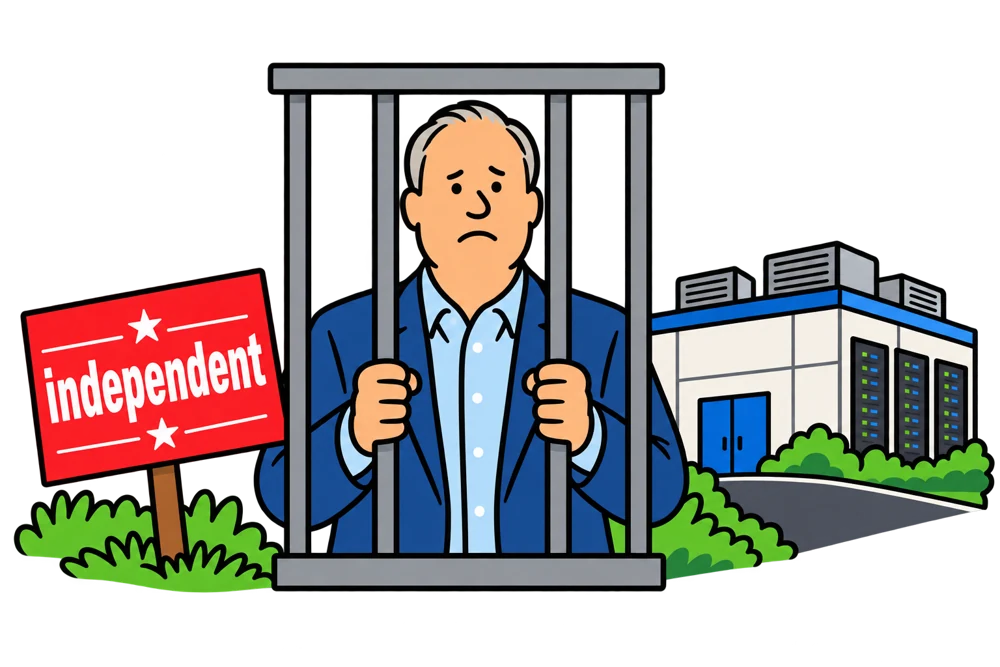
Elaine Beech is trying to reclaim her old seat as an independent. The departing incumbent’s arrest and a debate over data centers make it one of the most interesting races in the South.

Editorial cartoon of a red independent campaign sign, a data center and Brett Easterbrook behind symbolic bars.

A few days before this was written, a tweet put Alabama House District 65 on our radar and evoked memories of my early days of state legislative forecasting. In 2018, the first year I created a national set of state legislative predictions in most seats around the country, I overestimated Democrats in rural areas and underestimated them in the suburbs. In my defense, though, I was 19. One of the seats I greatly overestimated them in was AL HD-65, which I wrongly viewed as a safely Democratic district in Southwest Alabama, containing Choctaw and Washington counties, the northwest corner of Clarke County and a slice of northern Baldwin County.

Elaine Beech, a Chatom pharmacist, first won HD-65 as a Democrat in a 2009 special election and held it until Brett Easterbrook of Fruitdale, then a finance director at Outokumpu Stainless, beat her 52.8% to 47.1% in 2018. When an Election Twitter account noted that she’s making a comeback bid as an Independent this year, I immediately remembered the race and adjusted our forecast accordingly. This isn’t Beech’s first attempt at a comeback bid: in 2022, Beech switched to the Republican Party but was thrown off its primary ballot.

Easterbrook opted out of a 2026 re-election bid. In late 2025 he announced for Senate District 34 after Jack Williams left to run for Agriculture Commissioner, and then, on March 12th, posted that he failed to qualify for the race. John Knapp (R), a Tibbie resident with 23 years in law enforcement as a conservation officer, state trooper and county deputy, won the May 19th Republican primary to replace Easterbrook by 16 points.

Oh, and then there’s some recent news that probably doesn’t have an impact on the race, but is worth mentioning regardless: Easterbrook was arrested on October 2nd in a three-day Atmore Police-led undercover prostitution sting involving seven agencies and 17 arrests. He was booked on first-degree human trafficking and soliciting prostitution and released within the hour. The criminal complaint, reported by South Alabama News and later the Alabama Political Reporter, alleges he answered an ad posted by undercover officers and agreed to pay $500 cash for sex with an "escort" he believed to be a minor. The Escambia County district attorney amended the charge to attempted human trafficking, a Class B felony carrying two to 20 years, because the sting had no real victim. Easterbrook, the vice chair of the House Insurance Committee, voted last session for a bill allowing the death penalty for child predators.

While most Republicans are running away from data center development in the general election, Knapp is hoping to bring them to Choctaw County. That could be an opening for Beech, who said she "would not be told how to vote by any party” and is handing out red yard signs. In low profile races like these, it’s common for the candidates to not have a campaign website, and Beech is no exception, so we couldn’t find out whether or not she has a different stance than Knapp on data centers. Given public opinion polls on the subject, she could pull out a win if she highlights this as a major difference between her and her opponent, though our forecast gives Knapp a 85% chance of victory, projecting him to win by 7.5 points.

Crazy #4

HI HD-14Hawaii

Three Ways Out of a Crisis

Elle Cochran left the Democrats in March. Now the unions, the Chamber of Commerce and a Green organizer are all coming for her seat.

Three cartoon hands point toward a house being rebuilt beside a hibiscus flower.

The Green Party currently holds zero state legislative seats nationwide. Hawaii has never elected a Green Party member to its Legislature, and West Maui has not elected a Republican since 2002. On November 3rd, one of those streaks will probably end.

House District 14 is Lahaina, Kaanapali, Kapalua, Olowalu, Kahakuloa and parts of Waiehu and Maalaea, right in the heart of the August 2023 wildfires. More than three years later, only around 200 of the nearly 2,000 homes and businesses that were destroyed have been rebuilt, according to county data cited by Honolulu Civil Beat. Recovery, or the lack of it, is the top issue here, and it has turned a sleepy, reliably Democratic seat into the hottest race in the state.

The incumbent is Elle Cochran, a former two-term Maui County Council member who won the seat in 2022 with 54.8% in a three-way race and was re-elected in 2024 by 13 points over Republican Kelly Armstrong. On March 16th, Prince Kuhio Day, Cochran announced she was leaving the House Democratic caucus for the Republicans, handing the GOP its tenth seat in the 51-member chamber and its first double-digit caucus since the Lingle years. She told Hawaii News Now the switch was about getting "stronger advocacy" for a community that "felt left behind" during the recovery, and told Hawaii Public Radio she felt "very pushed out, like the door has been slammed in my face" by her former party.

Her former party has a different explanation. Cochran missed 51 of 60 floor sessions in 2025, an 85% absence rate she defends as being "boots on the ground" in Lahaina, and she was already staring down a Democratic primary challenge from Ashley Olson, president of the Hawaii State Teachers Association's Maui chapter. Switching parties meant she was unopposed in the August 8th Republican primary, where she collected 726 votes. Three Democrats vied for the nomination: Sne Patel, the sales director at Maui Resort Rentals and longtime president of the LahainaTown Action Committee, edged Olson by 64 votes, 995 to 931, with 2024 primary candidate Kanamu Balinbin placing third.

The wild card is Paele Kiakona (G), the Lahaina native who became the face of Lahaina Strong after the fire, leading the 175-day "Fishing for Housing" encampment on Kaanapali Beach and winning a seat on the Maui Board of Water Supply. He has assembled a very impressive endorsement list, with large labor unions and environmentalist groups backing his campaign. At a campaign event on September 29th, Olson, the Democrat who lost the primary by 64 votes, endorsed Kiakona over her own party's nominee.

Patel is not without friends. The Chamber of Maui's PAC, the Carpenters, IBEW Local 1260 and the Teamsters are with him, and Civil Beat's Sunshine Blog has framed the race as a union-versus-union proxy war, HGEA for Kiakona and the Carpenters for Patel. But a Democrat with business backing and a Green with the public sector unions are fishing in the same pond of left-leaning voters, and that is precisely the math Cochran is hoping puts her over the top. House Minority Floor Leader Diamond Garcia told Civil Beat in September that three-way races favor incumbents and predicted Cochran will win. Democrats, for their part, list HD-14 among their top pickup targets.

Our forecast gives Republicans a 10% chance of holding the district, with Kiakona as the favorite to win. Should that prediction prove correct, it would be the first state legislative district a Green Party candidate has won since 2012 when Fred Smith (G) won an Arkansas state legislative seat, and Smith only won after votes for his Democratic opponent, convicted of election fraud, were thrown out.

Interesting #4

KY HD-95Kentucky

Coal Country's Last Democrat

Ashley Tackett Laferty is one of the top electoral overperformers on the state legislative level, but she’s not seeking re-election this year. A familiar name is trying to keep the seat in the Democratic column.

A basketball, coal and a television showing a simple cartoon Tanner Hesterberg.

Kentucky's 95th House District, all of Floyd County and the Pikeville end of Pike County, voted for Donald Trump by roughly 58 points in 2024. It also re-elected a Democrat to the House the same day. Ashley Tackett Laferty, an attorney who unseated a Republican in 2018, beat Republican Brandon Spencer 56% to 44% in 2024, outrunning Kamala Harris’s performance here by 70 points.

She is the last Democratic legislator in Kentucky's coal counties and the only Democratic House member east of Lexington; her neighbor Angie Hatton (D) lost in 2022 (due in part to Republican gerrymandering), and the region's last Democratic senator, Robin Webb, whom Republicans amazingly failed to field a candidate against in 2022, switched parties in 2025.

On New Year's Day, Tackett Laferty announced on Facebook that she was done with the House and would instead run for Floyd County District Judge against incumbent Tyler Green. Kentucky House Republicans have been trying to take this seat back for eight years after holding it for a single term, having ousted Democratic Speaker Greg Stumbo in 2016, the year the chamber finally flipped to Republican control.

The Republican nominee is Tanner Hesterberg, a Prestonsburg resident with a Pikeville law practice who spent years as a WYMT and WKYT reporter and anchor before that. He had been one of the last-minute entrants in the 2024 election for Senate District 29, which was a write-in free-for-all among eleven candidates. Hesterberg, who ran as a write-in like everyone else, garnered 9.8% of the vote districtwide and placed fourth, but performed better in Floyd County by placing second with 20% of the write-in vote. He filed on December 17th as your standard "pro-life, pro-coal, pro-Second Amendment" Republican, and beat pastor Willie Crase Jr. 66% to 34% in the May 19th primary.

Typically, seats on the state legislative level like these flip to the opposite party once their incumbent either opts out of re-election or finally succumbs to political polarization. That may still be the case this year, but Democrats aren’t going down without a fight. Johnny Ray Turner (D), 76, a retired teacher and basketball coach, represented Senate District 29 from 2001 to 2021 and chaired the Senate Democratic caucus for over a decade. He filed on December 31st, the day before Laferty's announcement, and said, "I didn't want to leave when I did."

Turner lost re-election in 2020 to someone with a similar name: Republican Johnnie L. Turner. While Trump carried the Senate district by 59 points in the 2020 presidential election, Turner (D) only lost re-election by 7, outrunning President Biden’s showing in the district by 52 points. In Floyd County, though, Turner (D) won by 25 points. Turner (R) died in a lawnmower accident just two weeks before election day in 2024, creating the write-in free-for-all race to replace him.

Turner (D) admitted to the News-Express that this year's race would not be easy and that he would work with the Republican supermajority. In my nine years of watching state legislative elections, I’d tend to agree with Kentuckian Jack Siesko’s analysis that most comeback bids by Democrats in deeply conservative areas tend to fail because they can’t beat or even match their previous electoral overperformances. Our forecast projects Hesterberg to win by 6.7 points, with a 83% chance of victory. Turner's name still means something in Floyd County, but Hesterberg’s profile as a former local TV anchor is a net benefit: being a local TV anchor is one of the strongest backgrounds a candidate can have before running for public office, unless you’re Kari Lake.

Crazy #3

TN HD-93Tennessee

A Ballot with No Name

G.A. Hardaway's petition fell one valid signature shy in March. He died in April. His son was appointed, ran, quit and endorsed a candidate the state then barred as a sore loser. Memphis will elect a legislator by write-in with no threshold at all.

Cartoon hand examines a blank ballot beside a pencil and petition.

Tennessee House District 93 is a squiggly majority-Black district that runs through African-American neighborhoods in Memphis and its suburbs. G.A. Hardaway (D), the incumbent since 2006, won re-election with around 80% of the vote in 2022 and 2024. Normally, it’d be a race with a foregone conclusion, but a series of hiccups and screwups have made it an absolute mess.

In March the Shelby County Election Commission ruled that Hardaway's qualifying petition carried 47 signatures of which only 24 were valid, one short of the 25 required. His adviser blamed a signer whose address did not match her registration. Because nobody had bothered to challenge him in years, no one else from either party had filed, and the independent deadline of March 10th had already passed. HD-93 became the only legislative race in Tennessee with no names on the primary ballot. Hardaway vowed to pursue "all administrative, legislative and judicial options" and a write-in campaign. On April 24th he died at Vanderbilt University Medical Center at 71 after a brief illness. Two weeks later the Shelby County Commission appointed his son, Willis Lincoln "T.J." Hardaway III, an event organizer and athletic coach, to the interim seat.

The August 6th primary was a write-in-only affair: three Democratic write-in campaigns were announced, the Daily Memphian called it "wild, wild west", and then the field thinned under party pressure. The certified tabulation shows 996 Democratic write-in votes in total, 614 of them for County Commissioner Britney Thornton, who fell short of meeting the necessary threshold to win the nomination. That means there is no party nominee of any kind, and the November ballot for this office is blank; Republicans didn’t field a candidate here.

Which brings us to the general election. Whoever receives the most write-in votes wins, but only votes for candidates who are certified as write-ins by September 14th will be counted. On September 14th itself, T.J. Hardaway abruptly ended his own write-in campaign, said he was headed to law school, and endorsed Kyler Gilkey, naming himself Gilkey's campaign adviser and chief of staff. Gilkey had lost the August Democratic primary in neighboring House District 84 to Rep. Joe Towns Jr. with about 27%; when Towns resigned to become Criminal Court Clerk, the county Democratic executive committee handed the HD-84 ballot line to someone else, and Gilkey jumped districts. Within a day, State Elections Coordinator Mark Goins wrote the county commission directing it not to count write-in votes for Gilkey under Tennessee's sore-loser law, which bars a candidate defeated in a primary from having general-election write-ins counted.

Five write-in candidates did certify, according to Election Administrator Linda Phillips. The five certified write-ins are a thin field. John Bradley (D), an Orange Mound native who works for the Shelby County Public Defender’s Office, and Brandon “DD” Washington (D), a 22-year-old University of Memphis senior and former foster youth who drew 16,000 votes in a 2023 City Council race, both lost the May Democratic primary for County Commission District 10 to Lashanta Rudd and have simply moved their campaigns over to this seat. Mitchell Morrison (I) is a grocery-industry lifer, firearms instructor and Campaign for Liberty organizer who took 20 percent as the independent against Sen. Sara Kyle in 2024. Tommy Brewington, listed as an independent, and Calvin Lacy, whose party is not stated anywhere, filed in early September and have left no campaign footprint I could find beyond their names on the list.

For what our forecast is worth, all we know is that one of these people will be the next State Representative from the district. We have no projection to offer, only the certainty that somebody will win with a few hundred correctly spelled votes.

Interesting #3

SD LD-27South Dakota

Independents, DINOs, and Ranchers, Oh My!

The party that typically dominates Pine Ridge could not get a candidate onto the ballot. Now at least one of the reservation's two House seats will go to an independent, and both will if the Republican incumbent loses. In the Senate, a party turncoat is running for a promotion in a three-way race.

Cartoon cow and campaign placards beside House and Senate ballots.

South Dakota has not elected an independent to its Legislature since 2010. It is mathematically guaranteed to elect between one and three this November, partly due to a filing fiasco in one of the purple corners of the state.

South Dakota Legislative District 27 is Oglala Lakota, Bennett and Jackson counties plus eastern Pennington County, which is to say the Pine Ridge Indian Reservation and the white ranching towns around it. It elects two members to the South Dakota House as a multi-member district, and one member to the State Senate as a single-member district. The reservation precincts deliver enormous Democratic margins and the surrounding counties deliver enormous Republican ones, which is how a Republican rancher from Kyle and a Lakota Democrat have shared the district's two House seats for most of the past decade.

The district used to be Democratic-leaning, having voted for Joe Biden by 6 points in 2020, but has lurched rightward over the years: Donald Trump won this district by just 16 votes in 2024. Down the ballot that year, incumbent Liz May (R) led the field with 37%, fellow incumbent Peri Pourier (D) took the second seat with 34%, and Democrat Elsie Meeks finished third at 29%. In the concurrent State Senate race, incumbent Red Dawn Foster (D) won re-election by 4 points.

Both of the Democratic incumbents here, though, are effectively “DINOs,” or “Democrats-in-name-only.” Pourier and Foster are in the middle of each of their respective chambers ideologically, chambers that are each fighting their own civil war between the Freedom Caucus and the mainstream conservative establishment. On September 22nd, 2025, the eve of a special session, Pourier, elected as a Democrat in 2018, switched her registration to Republican, calling it "a strategic shift.” Term-limited in the House, Pourier then sought the Republican nomination for the Public Utilities Commission at the June state convention and came up eight votes short.

Pourier is now running for the open State Senate seat as an independent while still registered as a Republican in a three-way contest against a Democrat and a Republican. The Republican is Anthony Kathol of Martin, a registered engineer, small business owner and former Public Health Service commissioned officer who lost 52-48 to Red Dawn Foster in the 2024 one-on-one race. The Democrat is Celestine Stadnick of Kyle, Oglala Lakota, principal of Little Wound Middle School. The national forecast gives Stadnick a 69% chance of winning, with a projected lead of 3.2 points.

The State House race to replace Pourier is an even more crowded field. The only Democrat to file for either seat, Elizabeth Lone Eagle of Kyle, had her nominating petition challenged and was decertified and removed from the ballot in the spring. Lone Eagle refiled as an independent, and so did three others: Jay Yohner, who runs a hardware store in Martin and won a Bennett County Commission seat as an independent in 2024; Joe Flood, a teacher, writer and archery coach from Manderson; and Evangeline Poor Bear of Pine Ridge. Dakota Free Press noted that without the independents, the second seat would simply have gone unfilled and been appointed by the next governor. With little coverage of the race, our best guess is that all four of the independents will vote with Democrats, so one of the two House seats is marked as an “uncontested I/D” seat in our forecast; good luck trying to estimate or predict which of the four is most likely to win.

May, who has ranched and run a grocery store on Pine Ridge for 40-plus years and first ran for this seat as an independent herself in 2006, is hoping that the (R) next to her name and her base in the deeply Republican precincts is enough for her to scrape by. Our forecast puts May 2.9 points behind the independent field, with a 65% chance she loses the seat. Again, trying to forecast seats like these is as much of an art and guesswork as it is a science, so May pulling out a slight “upset” win would not be the least bit surprising.

Crazy #2

NC HD-62North Carolina

The Must-Not-Win

For Democrats to defy the odds and flip the North Carolina House, one of the most gerrymandered chambers in the nation, they have to win House District 62. They’re hoping that doesn’t happen.

A Democratic ballot oval partly covered by a blue sticky note reading please don’t, with a voter’s pencil hovering.

Sometimes in state legislative elections, people who say crazy and offensive things win anyway, even in purple districts. North Carolina House District 62 may be one of these instances. HD-62 is northwest Guilford County: Oak Ridge, Stokesdale, parts of north High Point and northwest Greensboro. It’s a district that has been tilting toward flipping blue in our forecast throughout the year, and is a necessary victory for Democrats to flip the North Carolina House.

The incumbent is John Blust (R), a Greensboro attorney and Army veteran around 70 who served in the House from 2001 to 2018, retired, and came back in 2024: he won a five-way Republican primary that March with 34% of the vote, was appointed to the seat in September when John Faircloth resigned early, and won the general election by 7 points. He’s the most moderate Republican in the chamber, according to our WNOMINATE vote analysis. The Democrat is Shelly Headen of Oak Ridge, a CPA and former corporate auditor who runs a garage-door company and a cattle farm with her husband, and a first-time candidate.

Through the summer this looked like a ripe pickup for Democrats: Blust only ran ahead of Trump’s performance in the district by 1 point, so he’s not an electoral overperformer, and Democrats didn’t put up much of a fight against him in 2024.

On September 10th, The Assembly's Bryan Anderson published Headen’s social media history: "Ready for the MAGAs to die off!!"; a LinkedIn post calling MAGA possibly "more destructive and evil than the Nazis"; a Facebook comment that "our only hope is an attack on US soil... preferably Alabama, Louisiana... where the stupid people live"; "I think America is beyond peaceful protest!" in reply to praise of Brian Thompson's killer; and a suggestion that Trump supporters "need to experience sexual assault." Headen told Anderson these were "a few angry moments," compared her sacrifice to Jesus, Martin Luther King and Lincoln, and disclosed that she had paid a consulting firm $30,000 to scrub her accounts before running.

Within hours the House Democratic Caucus withdrew its support "without qualification." The Guilford County Democratic Party followed the next day, pulling "all financial, operational and organizational support" and calling the language "completely indefensible." Breitbart then surfaced a Facebook photo of Headen at the Dachau crematorium captioned "This is where Trump supporters belong," which Headen said was edited and later said was AI.

She cannot be replaced. The withdrawal deadline was August 20th and absentee ballots went out September 4th, so her name stays on the ballot, as WRAL noted; if she won and declined to serve, Democrats could fill the seat through the vacancy process. Her story has moved around since. To the Rhino Times on September 17th she was "very, very sorry," had received death threats, blamed a dark-money opposition operation and said she would return donations and now "just wants to protect her family." At a September 24th forum she called herself "a victim of fake, generated AI." And on October 1st she told Carolina Public Press that she had originally planned to "recuse the seat if elected" but after "an outpouring of support" now intends to serve.

Still, our forecast views the race as a toss-up – this ain’t our first rodeo. In wave years like this, there’s always the possibility that a candidate like this wins. Our forecast projects Blust to win by 0.8 points, with a 55% chance of victory. The district will be a test of how well-informed voters are and how big of a blue wave crashes upon North Carolina.

Interesting #2

WV HD-27West Virginia

Jack Skellington’s Revenge

Ric Griffith narrowly lost a promotion in 2024. Now he’s coming back for his seat.

Cartoon Kenova Pumpkin House lined with jack-o’-lanterns beside a pharmacy bottle.

Wayne County Republicans did everything they could to tell their voters not to nominate Tyler Bowen. Bowen did too. The voters did not listen.

House District 27 is northern Wayne County, Kenova, Ceredo and Westmoreland, plus the southwestern corner of Cabell County and part of Huntington’s West End, running west to the Big Sandy River. It is ancestrally Democratic territory that has moved hard right at the top of the ticket, roughly R+32 for Trump in 2024, but it is not uniformly red downballot. In 2022 it was the closest House race in the state, with Democrat Ric Griffith holding it 50.8% to 49.2%, 2,064 votes to 1,995. Griffith left to run for Senate District 5 in 2024 and lost, and Republican Michael Amos took the open House seat with 64%, while Griffith carried his House seat by 2 points in the concurrent State Senate race. Amos did not file for re-election this year, leaving the seat open.

The Republican primary was a two-man race between Tyler Bowen, 38, a Westmoreland high school teacher and pediatric dietitian, and William Alex Caudill, a union meat cutter and Ceredo volunteer firefighter. In April, before a single vote was cast, Bowen notified the Secretary of State’s office that he had taken a job at Wellstar Children’s Hospital in Georgia, shut down his campaign page and publicly asked his supporters to vote for Caudill. On May 12th Bowen beat Caudill 356 to 327. His reaction on social media, as reported by WCHS, was one word: “Oops.”

Bowen moved to Georgia at the end of July. On August 10th the State Election Commission, acting on a written challenge from the Wayne County Republican chair, found him constitutionally ineligible for no longer being a West Virginia resident and removed him from the ballot. Because this was a disqualification rather than a withdrawal, under West Virginia’s 2024 ballot-vacancy law, the party was allowed to name a replacement, something it could not do for Elliott Pritt in House District 50 a week earlier (we’ll get to that race next).

The Wayne County executive committee’s pick was not Caudill, the man who had actually campaigned and came within 29 votes. It was Gordon Ramey II of Huntington, a retired Army National Guard major, former Huntington police chief and former Cabell County school board member, who had filed for the seat in January but did not make the May primary ballot.

Griffith, the 77-year-old Kenova pharmacist, former mayor and owner of Kenova’s famous Pumpkin House, is making a comeback bid for his old seat. You heard that right: Pumpkin House. In 1978 Griffith set a handful of jack-o’-lanterns on his porch, one for each member of the family. The count hit 3,000 around 2001 and has never come back down; the number was chosen to match one pumpkin for every resident of Kenova, and last year it passed 3,500. Every October more than a thousand volunteers show up at 748 Beech Street, an 1891 Queen Anne on the National Register that Griffith bought in 1991, to scoop, drill and jigsaw pumpkins at a pace of 400 to 500 a day, soak them in bleach water so they keep, and stack them up the railings and across the roof. Somewhere between 20,000 and 30,000 people walk past that porch each Halloween season, with visitors from all over the world coming to see an Appalachian wonder. Admission is free, donations are refused, and Ceredo and Kenova built an entire festival, C-K AutumnFest, around the crowds. In 2016 the display staged a “fourth presidential debate” between a Trump pumpkin and a Clinton pumpkin. The rest of the year Griffith fills prescriptions at Griffith & Feil Drug, the 1892 pharmacy his family runs on Chestnut Street, behind a soda fountain he spent three years restoring. This is retail politics in its purest form: a candidate who has personally handed something to a meaningful share of his district, every year, for decades. It is also the only sensible explanation for how a Democrat kept a Trump +32 seat in 2022, and for why he could only lose it by walking away from it.

Our forecast projects Griffith to win by 2.0 points, with a 62% chance of victory. Political insiders on both sides of the aisle also view him as the prohibitive favorite. The pumpkins go up the week early voting opens and come down the morning after Halloween, three days before the polls. Ramey has a good resume, but Griffith has 3,000 lit jack-o’-lanterns and a line down Beech Street to see them. In Wayne County, that has been the better ticket before.

Crazy #1

WV HD-50West Virginia

The Curse of the 50th

Elliott Pritt was arrested on federal child enticement charges in July, nearly four years after beating an incumbent with his own problems. Now it’s a six-way race with no Republican on the ballot.

Six pencils surround a six-row ballot beside an empty red chair and a question mark.

When you try and forecast every single state legislative district in the country, there’s always a few seats that slip through the cracks. West Virginia House District 50 was one of those districts in our 2022 forecast, where a district that we believed was guaranteed to be a Republican hold flipped to the Democrats. When we checked back, we fully understood why we were wrong.

This Fayette County-based district, which runs from Meadow Bridge through Oak Hill up to the river town of Boomer, was decided by a sex scandal in 2022. Incumbent Austin Haynes (R), an Oak Hill insurance agent elected in 2020 at 23, gave the district an October surprise when two weeks before the election, Beckley attorney Stephen New announced he intended to sue Haynes and the Legislature on behalf of a woman who had lobbied him on a bill during the 2021 session, alleging he offered to support it in exchange for sex and texted her that a female lawmaker had offered him the same trade because “it happens all the time.” Haynes’s texted apology, per 59News, was that he had “a little too much to drink.” The Register-Herald then published the messages, which included “I jacked off to one of your pics” and “Do you ever masturbate?”, and reported that roughly a dozen women had described the same pattern of late-night Facebook messages, among them Huntington City Councilwoman Tia Rumbaugh, who said Haynes started messaging her at midnight in March 2020 while both were first-time candidates.

Haynes lost to Democrat Elliott Pritt, a former Air Force staff sergeant who said he never used the allegations in his campaign while Haynes “came at me, both barrels blasting.” He won 1,892 to 1,759, 51.8% to 48.2%, in a district that had voted for Trump by roughly 50 points, the only Republican-held House seat Democrats flipped in West Virginia that year. “The people of the 50th delegate district made a choice, a moral choice,” he told the Fayette Tribune on election night.

Five months later, Pritt must have realized that being a member of a superminority party sucks. On April 17th, 2023, a month after his first session ended, Pritt walked into the Fayette County Courthouse with a handful of supporters and changed his registration to Republican, which left the House at 89 Republicans and 11 Democrats. In a letter to the House Democratic Caucus he said there was “very little room in the party for traditional values or differences regarding political opinion” and that the values of Fayette County “were no longer compatible with the trajectory of the Democratic Party.” Minority Leader Doug Skaff noted that Pritt had been one of the caucus’s loudest critics of Republicans only weeks earlier. State Democratic chair Mike Pushkin pointed out that Pritt had been a Socialist Party member and a Mountain Party candidate before he was a Democrat. Pritt won re-election with 66% of the vote in 2024, but this year he won’t be on the ballot, nor will any other Republican.

On July 22nd, Homeland Security Investigations and the Fayette County Sheriff's Office arrested Pritt, an Oak Hill High School teacher, on a federal complaint charging enticement of a minor. The complaint alleges he began messaging a female student on Roblox and then Snapchat during the 2024-25 school year, escalated to explicit photo exchanges that summer, and had five to ten sexual encounters with her in his classroom in late 2025, urging secrecy into July 2026. Speaker Roger Hanshaw stripped him of every role and joined GOP chair Josh Holstein in demanding his resignation; the state suspended his teaching certificate and the county board fired him. Pritt resigned the seat on July 27th from federal court. On August 1st the state Republican Executive Committee voted unanimously to formally disavow him, the first such action in the party's history. A federal grand jury indicted him August 19th on sexual exploitation of a child, coercion and enticement, and witness tampering.

The lack of a Republican on the ballot this year is the Legislature's own doing. In 2024 the Republican majority passed House Bill 4350, which allows a party to fill a general-election vacancy only after a disqualification, such as a felony conviction, and not after a voluntary withdrawal. Fayette County Republicans understood this and asked the State Election Commission to disqualify Pritt so they could name a replacement, with a hearing set for August 7th. Three days before the hearing, Pritt signed a notarized withdrawal at the Carter County, Kentucky, Detention Center. Secretary of State Kris Warner's response: "The law in this instance is clear." There would be no Republican on the HD-50 ballot.

Governor Patrick Morrisey filled the seat itself on August 25th, appointing Bill Vest of Oak Hill, a retired acting superintendent of the Beckley Correctional Center, from the county Republican committee's list of three. Vest then did the only thing available to him: he filed as an official write-in candidate on September 1st. So did Eric Walton, another of the three names the committee had sent the governor, and a "J. Pino" of Oak Hill whom we could not confirm to be former Democratic delegate John Pino. Three candidates will actually appear on the ballot. The first is Democrat Mathew Anderson, a 37-year-old special-education teacher at Divide Elementary and small business owner. The second is independent Tom Louisos, a former Fayette County Commission president and the son of a 22-year Democratic delegate of the same name, whom state Republicans reportedly favor over the governor’s own appointee. The third is the Constitution Party's Stacey Hensley.

That is the field in a district Republicans carried by 40 points two years ago: a Democrat, an ex-Republican independent, a Constitution Party candidate, and the actual Republican delegate running as a write-in along with two other write-ins, one of whom may or may not be a former Democratic delegate. This is one of those districts where I personally don’t put much stock into our forecast, because it’s just an absolutely absurd race with a ludicrous number of candidates. That being said, our forecast gives Anderson, the Democrat, a 11% chance of winning. But in a six-way race, there’s perhaps a better chance than what our forecast shows if the conservative vote is split enough for Anderson to win with a plurality of the vote; Kamala Harris did get 29% of the vote here, after all, and state legislative races in West Virginia run more Democratic than the presidential vote. At least this year we won’t be caught lacking: we recognize the room for upset here. The truth of the matter is that no one really knows what’s going to happen in this district: your guess is as good as ours. All we can hope is that the good people of this district finally get a Delegate who is without personal scandal.

Interesting #1

PA SD-46Pennsylvania

The Independent on the Menu

Camera Bartolotta survived a multimillion-dollar primary. Now Democrats have cleared their own line so an independent restaurateur can take her on one-on-one.

Cartoon restaurateur holding a ballot beside an awning and a Pennsylvania bridge fragment.

Nobody in Pennsylvania politics thought Senate District 46 was going to flip, up until a few weeks ago. Now, the calculus has changed in Republicans' quest to prevent a Democratic trifecta.

Located in Southwest Pennsylvania, PA SD-46 is all of Washington and Greene counties plus a sliver of southern Beaver County, ancestrally Democratic coal-and-steel country that has moved hard right since Barack Obama came onto the scene. Democrats have been bleeding losses since 2010, one of them occurring in 2014 when Camera Bartolotta (R) flipped this district by beating Democratic incumbent Tim Solobay 53-47. She won re-election by 18 points in 2018 and was left unopposed in 2022.

Despite the area continuing to lurch rightward during her tenure, she's now in the fight of her life. Al Buchtan, a Greene County masonry contractor and former school board member, ran a "drain the swamp" primary campaign against her from her right, and the money that poured in turned it into a proxy war between gaming interests: the skill-game industry funded a pro-Buchtan committee, while the pro-Bartolotta committee drew from rival casino and sports-betting money and the state party dropped at least $250,000 on her mailers. Bartolotta's allies challenged Buchtan's residency, since he listed a rented Canonsburg townhouse while owning a larger home in Greene County; a judge kept him on the ballot but ordered him listed as a Greene County resident, and the state Supreme Court upheld it. Buchtan hit her over mail-in voting and over past supportive comments about Charleroi's Haitian immigrants, which earned him a Jack Posobiec endorsement. Bartolotta won on May 19th, 53.5% to 46.5%, carrying Washington County comfortably but losing Greene.

While Bartolotta celebrated her primary win, Evan Snyder of Nottingham Township ran unopposed in the Democratic primary. Weeks later, Snyder withdrew on June 22nd. Washington County Democratic chair Christina Proctor told the Observer-Reporter the party "knew that was what he was planning on doing," and explained the point of running him at all: to "ensure Camera couldn't run a write-in on the Democratic side" and capture both nominations. Democrats then declined to fill the vacancy.

About ten days after the primary, Jodi Borello launched an independent bid. Borello, who has owned the restaurant Mia Cucina in South Franklin Township since 2000, spent four years as a community organizer with the Center for Coalfield Justice and co-founded a group linking fracking to childhood cancer. Her voter registration records show her as a longtime Republican who went independent in 2008, re-registered Republican in 2017 and switched back to independent this March. Bartolotta's read on all this is not subtle. "They pulled the Democrat off and put her on," she told the Mon Valley Independent, calling Borello "the AOC of Washington County" and arguing that "a Democrat can't win in Southwestern Pennsylvania today."

Data centers have become one of the top issues of the general election. Borello backs a three-year statewide moratorium on hyperscale facilities and repeal of their equipment sales-tax exemption; Bartolotta co-sponsored a bill allowing optional local moratoriums and says she voted to end the tax breaks, while warning that Borello's anti-fracking work would kill Mon Valley energy jobs. Borello says she would caucus with neither party, but political insiders on both sides of the aisle are saying she plans to caucus with the Democrats. One tell is an ad that borrows Shirley Chisholm’s slogan: “unbought by any donor, unbossed by any politician.”

The Pennsylvania State Senate is one of the most competitive state legislative chambers in the country, according to the State Navigate forecast. In September, the forecast viewed a Bartolotta victory as virtually certain. But at the beginning of October, Appalachian insiders put the race on our radar, suggesting that Borello was in a neck-and-neck contest. We decided to go into the field and see for ourselves, and our poll proved the insiders right: in early October, Bartolotta and Borello were tied 43-43. As of October 11, 2026, our forecast projects Bartolotta to win by 4.5 points, with a 76% chance of victory. Borello was, as mathematically expected, pulling significant Republican support: 20% of voters who say they supported Donald Trump in 2024 are backing Borello. To our surprise, Bartolotta is also enjoying significant Democratic support as well, with 12% of voters who say they supported Kamala Harris in 2024 backing Bartolotta. The poll produced the most eye-popping crosstab of the year for our polling committee, though: we had voters rate themselves ideologically on a scale of 0-10, from Far Right to Democratic Socialist. Of each ideological grouping right of center, the most likely to back Borello were the far right: 32% of voters who identify themselves as far right support Borello, with 58% for Bartolotta. Amongst other conservative voters, Borello only pulls 16-25%. That's a signal that the bad blood between Republicans in SD-46 hasn't subsided, and it could lead to a Democratic majority in the State Senate for the first time in over 30 years, just in time for Governor Josh Shapiro's upcoming landslide re-election victory and potential presidential bid.