Skip to the upsets

The Biggest Upsets
of the 2026 State Legislative Elections

A write-in in West Virginia. A fight over data centers in Kansas. A new majority in Texas.

When you forecast thousands of state legislative elections every two years, you’ll see statistics and probability work in real time on election night. Upsets happen, and remarkable ones occur regularly at the state legislative level, given the sheer number of state legislative seats and how small the districts are by population. This year was no exception: there are seat-level upsets which beat our forecasts by a country mile, and chamber-level upsets that were driven by statewide environments that didn’t match our expectations. As a sort of sequel to one of our favorite articles this year, The 20 Strangest State Legislative Races of 2026, here are the Biggest Upsets in the 2026 State Legislative Elections.

The upsets

AL SD-10

Pick Your Battles
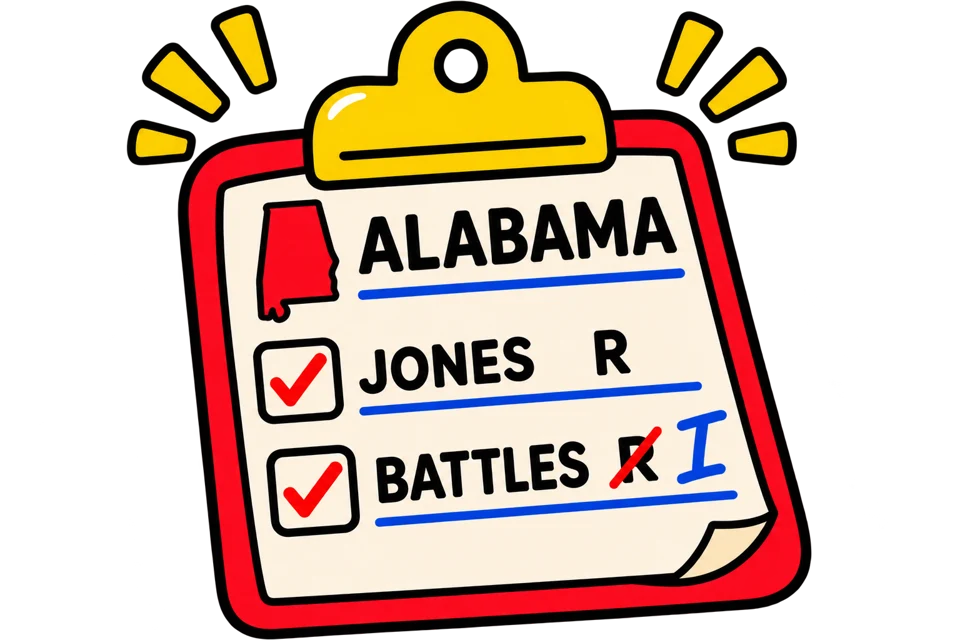
Ballot showing Jones and Battles, with the R beside Battles crossed out and replaced by I.

Sometimes, when forecasting state legislatures, there are what I like to call “the districts that slip through the cracks.” We work hard to keep all our ratings up to date and look for any oddball candidates or stories in state legislatures, especially this year. Usually, there are around a dozen districts in our forecasts where upsets occur because of a lack of awareness of the intricacies of a race. This year, we whittled these errors down to two.

Our first error is in northwest Alabama’s State Senate District 10, containing part of DeKalb County and all of Cherokee and Etowah Counties. Jesse Battles planned to run in the Republican primary here earlier this year, but the state party kicked him off the ballot over allegations that he worked as a political consultant for former Minority Leader and current Gadsden Mayor Craig Ford (D) when Ford ran as an Independent here in 2018.

Battles decided to run as an Independent in the general election instead. Our forecast has seen this song and dance before (Ford lost by 21 points in 2018) and determined there was a >99.9% chance the Republican incumbent, Andrew Jones, would win re-election. We were unaware of the circumstances around this race, though; we simply saw an Independent on the ballot. Only in Louisiana and Mississippi have Independent candidates won a general election in recent years. Battles won by 52 votes out of more than 45,000 cast, a 0.1% margin of victory. A recount is scheduled but unlikely to overturn the result and unseat Battles, who has been sworn in. He owes his victory to a dominant performance in Etowah County, containing Gadsden; Battles carried Etowah by 12 points. Battles is a conservative independent, so he probably caucuses with the Republicans, but we’ll have to wait and see if he wants to play ball with the party that threw him off their primary ballot.


WV HD-12

The Sore-Loser-Spoiler

A yellow pencil touches the write-in line on a ballot.

This is the “other” race that slipped through the cracks, and it wasn’t because we were unaware of it. I was told that Republican incumbent Vernon Criss of Parkersburg was running a write-in campaign for WV HD-12 after he handily lost his Republican primary to Charles Hartzog, a 23-year-old Walmart employee backed by Governor Patrick Morrisey. West Virginia has a “sore loser” law, but it doesn’t prevent a sore loser from running a write-in campaign.

Despite this, we were skeptical Criss would garner enough votes to change the outcome of the race. We should have listened to in-state experts, because despite our forecast giving Hartzog a 99.2% chance of victory, Democrat Dennis Rempel won this district that voted for Trump by 27 points in 2024, despite a lack of ancestrally Democratic voters. Thanks to Criss’s write-in campaign and the presence of a Libertarian on the ballot, Rempel pulled off the second-biggest upset in the country, at least in our forecasts’ book. Rempel won with 46% of the vote to Hartzog’s 42%, while Criss garnered 7% and the Libertarian garnered 6%. Mea Culpa.

KS HD-123 / CA AD-33

Revenge of the Latinos

A ballot box stands between a Kansas grain elevator and a California orange tree.

One thing that broke some of our district-level forecasts was how hard Latinos ended up swinging to Democrats, and how many of them turned out to vote in a midterm election. Democrats pulled off two major upsets thanks to their enormous gains with Latino voters this year: KS HD-123 in Garden City, and CA AD-33 in the Central Valley.

Democrats had just a 0.9% chance of flipping KS HD-123, a Trump +28 majority-minority seat with a lot of dormant Latino voters that rarely come out to vote, and the ones that do typically support Republicans. A switch flipped this year, and Democrat Becca Burnfin flipped the district by 2 points. Other parts of southwest Kansas also swung heavily Democratic due to their Latino population, including the towns of Liberal and Garden City. In those latter two towns, Democrats didn’t even field a candidate for the State House seats, which they probably would have won.

In CA AD-33, the story repeats itself: Democrats were given just a 2% chance of flipping this 70% rural Latino seat that voted for Trump by 19 points in 2024. But a hydrogen bomb was dropped on Republicans in the Central Valley up and down the ballot (e.g., David Valadao losing re-election by over 30 points in the race for Congress here), and as a result, it looks like the California Assembly Minority Leader, Ali Macedo (R), will lose re-election to the 28-year-old Mayor of Lindsay, Hipolito Angel Cerros (D).

KS HD-43

Build It, and They Will Come (For Your Throat)

A homeowner protests beside a bank of data center servers.

Data centers were one of the hot-button topics of the midterm elections, and they’re proven to have large effects on smaller races. Three weeks before the election, The Economist found that Trump voters within 2km of a newly announced/built data center were more likely to say they’re voting for Democrats in the upcoming election than Trump voters >2km away from one. Anger against data centers almost flipped a West Virginia House district that voted for Trump by 57 points to the Democrats, but Republicans eeked out a gnat’s-eyebrow victory there.

Republicans in Kansas, though, weren’t fortunate enough to beat the data center backlash. Located in southwestern JoCo (Johnson County, where the Kansas City suburbs lie), KS HD-43 Democrat Kristen Schultz took up the mantle of the “anti-data center” candidate in a community where a proposal to turn a 378,000 sq. ft. warehouse into a data center has voters in an uproar. Incumbent Republican Bill Sutton lost re-election by just two points.

NC HD-51

Jackpot

A slot machine lands on three ballot envelopes.

Located in Lee County and parts of Moore, this is our second upset in this article where an Independent was woefully underestimated. This rural district voted for Trump by 26 points in 2024, and Independent April Montgomery was up against Republican Charles Taylor for the open race in NC HD-51. Not since 2010 has an Independent won a state legislative election in North Carolina, so our forecast felt pretty comfortable in seeing Taylor as the favorite, with a 98.4% chance of victory.

Taylor came under fire in the final stretch of the campaign, though. An ethics complaint said he hadn't disclosed that he owns a property on Tramway Road reported to be a video-gambling parlor; he sued a PAC for libel over mailers calling it "an illegal gambling operation"; and state Alcohol Law Enforcement received a gambling complaint about the property, per The Rant. Those attacks seem to have propelled Montgomery to victory, in adjunct to low Republican turnout in the district.

The Indiana House

Bayh One, Get 21 Free

A blue domino bearing Beau Bayh’s portrait tips toward legislative desks.

Part of why our Indiana forecasts did poorly this year is that they were largely locked into an electoral environment that generic ballot polling averages showed as the most likely scenario; most of our other state-legislature forecasts were closer to a double-digit Democratic generic ballot nationwide. That’s on me for forgetting to update the forecast on my end, and that mistake turned out to be a grave one.

Beau Bayh (D), son of former Governor and Senator Evan Bayh, won the Secretary of State race handily, beating Republican Max Engling by 9 points in this deep-red state. As someone who said in the final weeks this would be a 2008-esque environment, perhaps I should have been more literal with that prediction in that Indiana would flip Democratic: the US House popular vote in Indiana was D+4 this year.

Bayh’s coattails knocked our forecast’s teeth out. Going into the election, the main discussion for the Indiana legislature was whether Democrats would break the supermajority in the State House. To do so, Democrats would need to flip just 4 seats in the chamber: our forecast showed a toss-up race, with a 56% chance Democrats would break the supermajority and a 44% chance Republicans would keep it.

Democrats nearly flipped the Indiana House, the biggest statewide shock in our forecasts. They flipped 16 seats in the chamber, and were just 1,400 voters away from winning a majority. Bayh drew national attention for a lowly state row officer race, and the resources that came with it in a state that Republicans felt was safely Republican had down-ballot consequences. It is the largest Democratic net gain in the chamber since the 1974 Watergate Wave.

The “Bayhslide” resulted in major upsets to our forecast, including the Indiana House Speaker, who had a 94% chance of winning in our forecast, losing re-election. A total of 8 seats in the legislature where Republicans were given a 90% chance or higher of winning ended up going to Democrats instead.

If 2028 is anything like 2026, Democrats could conceivably flip the chamber and, with the State Senate and Governor's race up, win a trifecta. Two years is forever in politics, though. If Trump’s approval improves, Republicans should hold their trifecta here. Otherwise, they’ll need to have all hands on deck to prevent the first Democratic trifecta since the 1960s.

UT HD-62

David Chappell? The Queer Democratic Socialist?

David Chappell studies a blueprint in front of the Utah mountains.

Provo. Located in the heart of Utah, the city is the Mecca of the LDS Church. The incredibly youthful city with a growing Latino population was once upon a time one of the most Republican parts of the country just over a decade ago. But the times, they are a-changin’, in the words of Bob Dylan. UT HD-62, located in Provo, elected a Democratic Socialist engineer who graduated from Brigham-Young University over its incumbent Republican State Representative, who has held the seat for just over a decade.

Democrat David Chappell was given just a 2% chance of flipping this district. Democrats seemed rather bullish on his chances, though, in the lead-up to the election. Perhaps that’s our fault for not checking in with Utah Democrats, especially on a district that re-elected Norm Thurston (R) by 31 points in 2024. Chappell currently leads by 5 points, pulling off one of the most remarkable upsets in the nation.

Something that also caught my eye that may have helped Chappell is his website. In my 9 years of following state legislative elections, I’ve never seen a candidate’s website disclose their own donors and give a summary of who has donated to them and how they’ve spent their money, up until now. In a year where perceived corruption has angered voters, this level of transparency likely helped Chappell establish trust with voters despite his left-wing stances in a district that voted for Trump by nearly 20 points in 2024.

NY AD-49

Brooklyn Strikes Back

An elevated train passes above Brooklyn shops.

Lester Chang (R) flipped this seat from longtime incumbent Peter Abbate Jr. (D) in 2022, survived a challenge to his residency after Assembly Democrats declined to expel him, and handily won re-election in 2024. Our forecast was perhaps too bullish on Republicans holding their gains with Asian voters in southern Brooklyn’s AD-49: Chang had a 97.9% chance of winning re-election against Joyce Xiaoqiong Xie (D), but Xie pulled off a major upset, ousting Chang by 6 points.

This Trump +20 district was supposed to be an easy hold for Republicans, with Chang expected to win by double digits. But working-class voters of all races revolted against the Republican Party this year, especially those who used to vote Democratic over a decade ago. Seats like this will be ones to watch in 2028 to determine whether Democrats have definitively won these voters back, for now at least.

CT HD-77

Post Mortem

A phone displays a house and yard flag beside a cluster of comments.

State Representative Cara Pavalock-D’Amato (R) is no stranger to controversy, but she’s won re-election time and time again anyway thanks to the reliably Republican lean of CT HD-77, located in the town of Bristol, Connecticut. The seat narrowly voted for Donald Trump in the 2024 presidential election, but Connecticut Republicans usually have ticket-splitting support, and Pavalock-D’Amato is no exception.

Then she made a name for herself again earlier this year. During Governor Lamont’s address to the legislature, she turned her back to him as he voiced his opposition to ICE’s operations in the state. She wore a blazer that read “ICE IN” and gave the Governor two middle fingers.

She did it again in October. On Oct. 3, a month before the election, she posted a photo on Facebook of a Bristol home flying an anti-Trump flag, with a woman standing in the driveway and the street name in the post. She wrote that the woman had yelled in her face a couple of years earlier while she was knocking doors with her kid in a stroller. The woman, Caroline Gerard, told CT Insider she had never met Pavalock-D’Amato. The post drew more than 1,000 comments, some of them suggesting violence, and the family, who said they were being doxxed, went to the police. Bristol police found no threats in the post. Pavalock-D’Amato didn’t apologize: she said no house number was included and accused Bristol Democrats of doxxing her in 2022. Even House Minority Leader Vincent Candelora said officials should avoid picking fights.

Our forecast mistakenly read her 2024 re-election, where she won by 38 points, as a victory over a Democrat, but it was actually against a third-party candidate. In 2022, she only won by a single point against a Democratic candidate. As a result, she was projected to win by 14 points with a 97% chance of winning, but instead she lost to Democrat DeWayne K. Wynn Jr. by 12 points. Given Governor Lamont’s popularity in the state and the public’s perceptions of ICE (especially in a district that is 12% Latino), it’s no surprise that she lost handily in hindsight, which is always 20/20.

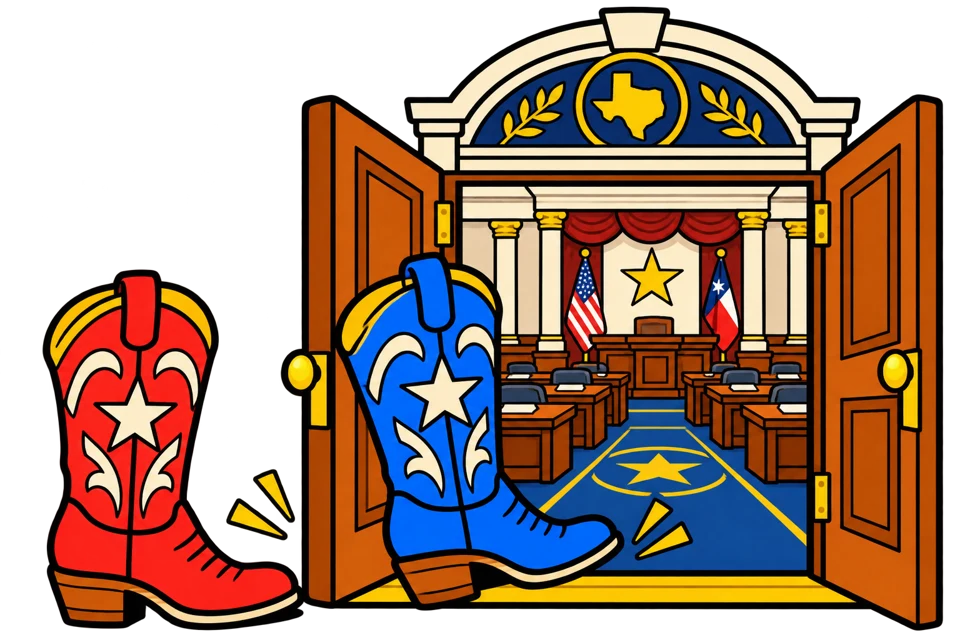
The Texas House

Lone Star Landslide

A blue cowboy boot crosses the chamber threshold beside a red boot.

We were not terribly surprised Texas Democrats won the State House this year: a few weeks before the election, a trusted in-state source told us the odds of it occurring were likely higher than our forecast showed. We had Democrats flipping 8 seats in the chamber, just 6 short of a majority; their overall odds of winning the majority were 23% (with a 3% chance of a tie).

But as we suggested in Total Recall Bias, if there was going to be one state where recalled votes would prove wholly inaccurate, it would be Texas, given its demographics. That hypothesis turned into theory when Gina Hinajosa (D) comfortably won the race for Governor. As a result, an astonishing 21 seats flipped to the Democrats, their largest net gain since the end of Reconstruction in 1872. With that net gain came astonishing upsets in 7 seats that Republicans had a 90-98% chance of winning: HDs 93, 89, 96, 14, 127, 28, and 126. These seats largely weren’t on anyone’s radar, and a similar story of what was deemed competitive and uncompetitive repeated itself in the Georgia House, which also flipped to the Democrats. Large minority turnout, coupled with enormous swings to Democrats among these subgroups, propelled Democrats to majorities in both chambers. Texas was more shocking, though, given the Democratic path to the majority and their overall final odds.